
If only I had a pound for every time someone had said this to me in my 12 years of being a virtual assistant, I would be a rich woman! And as AI has become more prevalent, we are coming across it again.
I decided to ask ChatGPT what it thought. This was the conversation…
“I love you ChatGPT” (we’ve got to be nice to our future overlords), “but can you tell me whether AI will replace the virtual assistant industry in the future?”
“Ah Gwen, that’s kind of you — but here’s the honest truth: AI is brilliant, but it’s not coming for a virtual assistant’s job any time soon. And it’s certainly not coming for the good ones.”
Maybe it was just saying what it thought I wanted to hear (does AI do that?) But that was the AI answer.
So, now it’s my turn!
But before we start, I would like to say that when people say this to us, they obviously do not understand the VA industry (usually, they assume all we do is data input or basic admin tasks), and more often than not, the comment isn’t innocent; it’s meant to spark a reaction. It’s a bit of a power move; a way to throw you off balance and take control of the discussion instead of having a genuine, constructive conversation.
But anyway, let’s move on and look at why us VAs are here for the long haul, and will absolutely not be obsolete any time soon!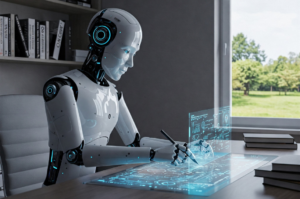
Our Skillset:
Virtual Assistant is an umbrella term; it covers a whole raft of services from basic admin all the way through to accountancy or web design.
The difference between AI and virtual assistants in any of these services is the human touch and emotional intelligence. So, for example, email management isn’t just sending someone a reply; it needs someone to understand priorities, the tone of the conversation, what the relationship is with that person, the risks and the consequences of saying something.
Human Touch:
When clients outsource to a VA, trust is a massive part of that relationship. They trust that we will maintain confidence, understand legislation and ethical practice, that we will spot gaps and anticipate next steps and often act before a client even realises they need something.
As VAs, we also aim to work cohesively with our clients. We understand their personality, their quirks, their pressure points and work style, and whilst AI does adjust to its inputs, it can’t access the behavioural cues that a human does.
Certainly, at present, it will only do what it is asked to do (and sometimes not even that!) and is fully reliant on a human to ask it to do that, which leads me to my next point….
Tech Support:
Not everyone is comfortable with online tools and AI, and this has opened up a whole new service option for us VAs, setting up, managing, educating and working with online and AI tools for our clients and taking the pressure off of them.
Fundamental flaws of AI:
AI will improve; this is a given, but at present, there are some obvious flaws with how it functions. There is already evidence that it has picked up on the biases of the humans who programme it, but also, there are some serious issues around data protection, and certainly GDPR. So, you need to be really careful if you need it to process personal data of any kind. KoffeeKlatch added an informative blog about ChatGPT and data protection (read this here: https://www.koffeeklatch.co.uk/chatgpt-and-client-data/). There are other helpful blogs about other AI platforms on the KoffeeKlatch blog too.
People’s perception of AI:
Now, don’t get me wrong, AI is a magnificent creation; it has made life a little bit easier, and it has helped people to create things they may have otherwise not felt confident enough to do, and I have no qualms with that. But what I people do have an issue with is that it hides the real human behind the business. We are sociable beings, and we want to know who we are doing business with and get to know them (this is why networking is such a successful method of marketing).
Let’s give an example: your parcel hasn’t arrived, you go onto the supplier’s website to ask where it is, but all you get is a chatbot – how long before you are screaming at the computer, “I just want to speak to a human!”?
We are already seeing posts shaming people for using AI to write their social media posts, blogs, courses and learning materials. People want to see and get to know the humans behind the business. After all, it’s the humans who are the experts and who have the experience in their field, yet they are using AI to write things for them.
Should we be concerned about what AI is doing to our brains?
Just a little side thought, and AI hasn’t been around long enough to answer this one, but as an industry, we are seeing a heavy reliance on AI from clients at present. Quite often, instead of thinking about what they write, they turn straight to AI for the answer. Does this make our brains lazy? The brain is a muscle; is it a case of use it or lose it? I don’t know, but I watched a discussion with Dr Karan recently that looked at scans of ChatGPT regular users showing that brains are being rewired to develop a reliance on it (You can watch a clip of that here: https://shorturl.at/2UfcJ)
I’d be interested to hear people’s thoughts on that.
VA Industry – patterns over time
The VA Industry is one of the fastest-paced industries out there; our roles are evolving constantly. The types of services I offered 12 years ago have changed dramatically, and I expect that will continue to be the case. But what VAs have an incredible knack of doing is evolving with it. When cloud tech came in, we adapted to it; when voice recognition came in, we adapted to use it in our arsenal.
Now we are dealing with AI, and instead of thinking ‘oh, that will replace us’, we’ve taken it on as an additional tool and run with it. We are now offering AI tech services to our clients and adapting our existing services to tie in with it.
A great example of embracing change was in the Pandemic when everyone started holding meetings and conferences on Teams and Zoom, the VA industry started offering meeting support and background support, and it was a booming service for the entirety of the Lockdown and beyond.
As VAs, we ignore new technology at our peril, and actually, we tend to jump on new technologies and embrace them.
If you speak to any successful VA, they will share with you about how they have adapted and changed their business to incorporate AI into their existing services and to offer new services.
I honestly, truly believe that AI is just another tool in our toolkit and that it absolutely will not replace virtual assistants. Having looked at the way the industry has changed in the last 15 years of UK VA Surveys, I can say with certainty that we will adapt to its presence.
AI will change and improve; it is growing constantly, and it will improve, but we will mould ourselves around it, and we’ll still be here to offer first-class VA support to our clients for a long time to come.